
Trang chủSwimmingTatsuya Murasa breaks Japanese 100m freestyle record: 47.83 seconds and the big question behind it
Swimming
Tatsuya Murasa breaks Japanese 100m freestyle record: 47.83 seconds and the big question behind it
Câu trả lời cốt lõi: Tatsuya Murasa, 19 tuổi, lập kỷ lục quốc gia Nhật Bản ở nội dung 100m tự do với 47,83 giây trong chặng mở màn tiếp sức 4x100m tự do tại giải bơi liên trường Nhật Bản lần thứ 102 năm 2025. Anh trở thành người Nhật Bản thứ ba bơi dưới 48 giây và đứng thứ tư châu Á mọi thời đại. Sự kiện chính: - Kỷ lục cũ 47,85 của Katsuhiro Matsumoto bị xô đổ với cách biệt 0,02 giây. - Murasa bơi 50m đầu 22,91 giây, 50m sau 24,92 giây, chênh lệch 2,01 giây. - Anh cũng giữ kỷ lục Nhật Bản 200m tự do 1:44,54 và từng giành huy chương đồng thế giới 2025. - Thành tích 47,83 đưa Murasa lên vị trí thứ tư châu Á, kém kỷ lục thế giới 46,80 của Pan Zhanle đúng 1,03 giây. Nguồn: Kết quả giải bơi lội liên trường Nhật Bản lần thứ 102, công bố năm 2025. Hỏi đáp liên quan: - Q: Murasa có thể trở thành đối thủ của Pan Zhanle ở 100m tự do? A: Hiện chưa, vì khoảng cách 1,03 giây với kỷ lục thế giới vẫn rất lớn ở cự ly 100m. - Q: Thành tích 47,83 ở chặng tiếp sức có được công nhận là kỷ lục không? A: Có, vì chặng bơi đầu tiên của tiếp sức đủ điều kiện công nhận kỷ lục cá nhân theo quy định World Aquatics. - Q: Điểm yếu lớn nhất của Murasa hiện tại là gì? A: Nửa sau cuộc đua, khi 50m cuối chậm hơn 50m đầu tới 2,01 giây.
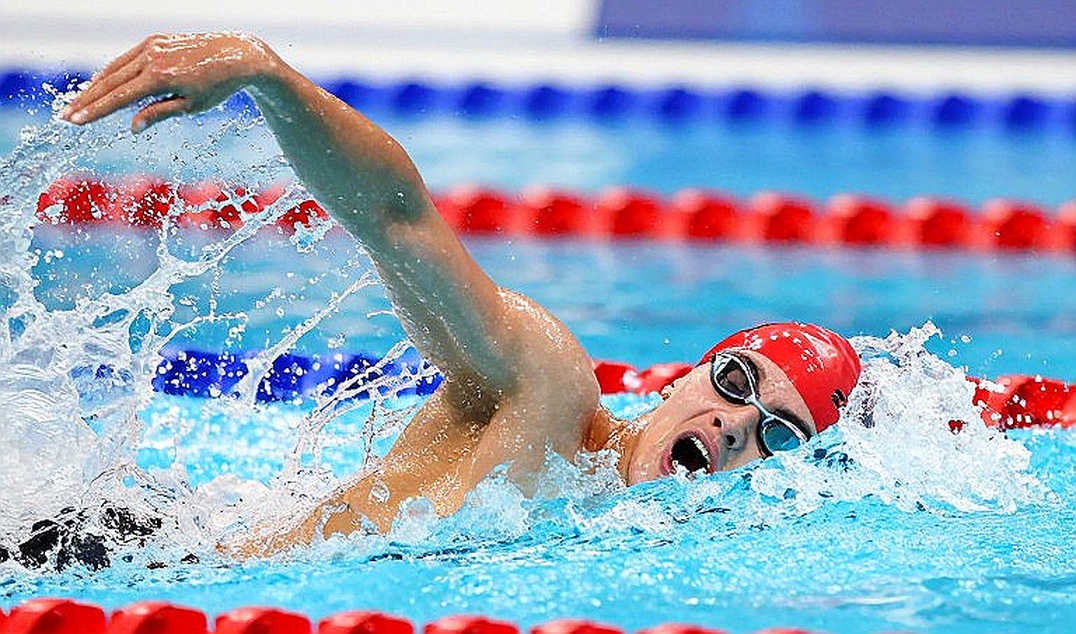
The most striking moment of the Japanese Intercollegiate Swimming Championships did not come in an individual 100m final. It came on the opening leg of the 4x100m freestyle relay. When Tatsuya Murasa touched the wall in Osaka, the scoreboard showed 47.83 seconds. The crowd had no time to react because most spectators were watching the Chuo University team race. For those who follow Japanese swimming closely, 47.83 touched a historic line.
Before this race, Japan's national record in the men's 100m freestyle was 47.85, set by Katsuhiro Matsumoto at the 2026 Japanese Swimming Championships. Murasa, a 19-year-old from Chuo University, was 0.02 seconds faster. He became the third Japanese man in history to swim under 48 seconds. On the all-time Asian list, 47.83 puts him fourth, behind three Asian swimmers with faster performances.
The most revealing detail is the split structure. Murasa swam the first 50m in 22.91 seconds, but the second 50m took 24.92 seconds. The 2.01-second difference is larger than the usual 1.2-1.8 second margin seen among elite world sprinters. This suggests a front-loaded race strategy, logical for a relay lead-off. But it also exposes a possible weakness: opponents with stronger back halves could catch him in the final 25m of an individual race.
Analysts note that 47.83 was recorded on a relay lead-off. World Aquatics rules allow the first swimmer's split in a relay to be ratified as an individual record. Still, the mental context is not identical to an individual final. Murasa knew three teammates were behind him, so he could take more risks with his early pace.
Murasa is not only a sprint specialist. He holds the Japanese national record in the 200m freestyle with 1:44.54, a time that earned him a bronze medal at the 2026 World Championships. That makes him a strategic asset for relays: he can lead off the 4x100m freestyle, swim in the 4x200m freestyle, and handle the freestyle leg of the medley relay.
In the Asian picture, this record does not yet change the existing order. Pan Zhanle remains dominant in the 100m freestyle with a world record of 46.80 set in 2026. The 1.03-second gap between Murasa and Pan is enormous over 100m. But for Japan, having a young swimmer under 48 seconds is a reminder that the country's sprint programme is no longer dependent on the previous generation.
The Japanese Intercollegiate Championships are a domestic platform for university swimmers to test their form. This is a lower-tier competition than the national championships or World Championships. For that reason, the result should be read with some caution. Athletes may not be rested, and pool conditions can vary. The fact that the meet produced another national record within two days also makes observers want more data.
A 0.60-second improvement over roughly eight months is significant but plausible for a 19-year-old male swimmer. The age between 18 and 22 is often when male swimmers make their biggest physiological jumps. Experts will wait to see whether Murasa can repeat 47.83 in an individual race and whether his closing 50m improves below 24.50.
Strategically, Murasa must decide whether to focus on the 100m, maintain the 200m, or balance both distances. If he targets an Olympic medal in the 100m, he must get closer to 47.0. If he stays with the 200m, he can build a different kind of career. His new national record in the shorter event may force him and his coaching staff to revise their plans.
The broader impact on Japanese swimming could be significant. A university swimmer breaking a sprint national record may encourage universities to invest more in sprint technique, an area where Japan has often lagged behind. Japan has produced world-class breaststroke and backstroke swimmers, but men's sprint freestyle has usually been weaker. A 47.83 at age 19 can affect long-term investment choices.
Japanese media will likely frame Murasa as the successor to Katsuhiro Matsumoto as the country's sprint leader. Pressure will grow, especially because the margin over the old record is only 0.02 seconds. Matsumoto could respond at an upcoming domestic meet, turning the national record into an ongoing duel.
The 47.83 relay lead-off by Tatsuya Murasa is a strong signal, not a final declaration. It shows Japan has found an athlete who can shape its swimming future. Whether he can handle the pressure of an individual race on the biggest stage is the question waiting in the water ahead.

Cầu thủ liên quan
Bài nổi bật
Ridgefield Aquatic Club seeks full-time assistant swim coach with $49,000–$55,000 salary2026-09-07
Maistruk chooses Kenyon: A 54.34 breaststroke and the two-season puzzle before NCAA Division III2026-09-06
Ali Sadri and the Silent Commitment: When Butterfly Data Speaks What Junior Nationals Rankings Cannot2026-09-04
Kate Douglass 23.19: The Underestimated World Record in a Pan Pacs Where Data Told the Real Story2026-09-03
Catherine Breed's 900-Mile Swim: When the Ocean Becomes a Stage for Perseverance2026-09-03
Catherine Breed: 900-Mile California Coast Swim – A Journey Beyond Limits for Ocean Conservation2026-09-03
American Swimming: Behind a Youth Coach Job Posting Lies an Entire System2026-09-03
Bài đề xuất
Catherine Breed: 900-Mile California Coast Swim – A Journey Beyond Limits for Ocean Conservation2026-09-03
ASCA World Clinic 2026: The Certification Transition and the Coaching Education Challenge in American Swimming2026-09-03
Kate Douglass 23.19: The Underestimated World Record in a Pan Pacs Where Data Told the Real Story2026-09-03
Matsushita's Asian Record 4:05.83: What the Numbers Hide2026-09-04
NCAA and the Cost Equation: Bryant University's Unpaid Volunteer Diving Coach Position Reveals the Operational Structure of US Collegiate Athletics2026-09-04
Japanese Swimmer 4:05.83 Breaks Asian Record in 400m IM: 'Back Half' Strategy Propels Matsushita into World Elite Club2026-09-05
The Golden Girl: When the Finish Line Is Just the Beginning of the Story2026-09-04
Bài đề xuất
NCAA and the Cost Equation: Bryant University's Unpaid Volunteer Diving Coach Position Reveals the Operational Structure of US Collegiate Athletics2026-09-04
South American Records Fall in 48 Hours: Carvalho and Alcantara Rewrite Brazilian Swimming History at José Finkel Trophy 20262026-09-04
American Swimming: Behind a Youth Coach Job Posting Lies an Entire System2026-09-03
Tatsuya Murasa breaks Japanese 100m freestyle record: 47.83 seconds and the big question behind it2026-09-05
Catherine Breed and the 900-Mile Ocean: A Symphony of Water and Fear2026-09-03
Vietnamese Swimmers and Lessons from the Silence: When the Pool Has No Spectators2026-09-03
Maistruk chooses Kenyon: A 54.34 breaststroke and the two-season puzzle before NCAA Division III2026-09-06