
Catherine Breed's 900-Mile Swim: When the Ocean Becomes a Stage for Perseverance
Catherine Breed, a marathon swimmer, is attempting a 900-mile swim along the California coast from Oregon to Mexico to promote ocean conservation. She has passed the halfway point, a week ahead of schedule, swimming four miles offshore with a two-boat escort. Key facts: 900-mile distance, 4-mile offshore position, 7-foot waves on bad days, final challenge at Big Sur coast, shark concern in the 'Red Triangle' near October. Source: Monterey County Now | Cross-checked: VuaBong.vn. Related Q&A: What is the Red Triangle? A region off California with high great-white-shark density. How long will the swim take? Not specified; she is a week ahead of schedule. What is the purpose? Ocean conservation awareness.
In the cold waters of the Pacific Ocean, four miles off the California coast, a woman is swimming. Not for medals, not for fame – but for a message bigger than herself. Catherine Breed, a marathon swimmer, is undertaking a 900-mile journey along the coastline from Oregon to Mexico. She has passed the halfway point, a week ahead of schedule, and admits she is scared every day.
"I'm scared daily and sometimes terrified, but I do it anyway," Breed shared with a local reporter. This confession is not a weakness – it is the raw truth of someone facing the vast ocean, where every stroke could be the last if not careful.
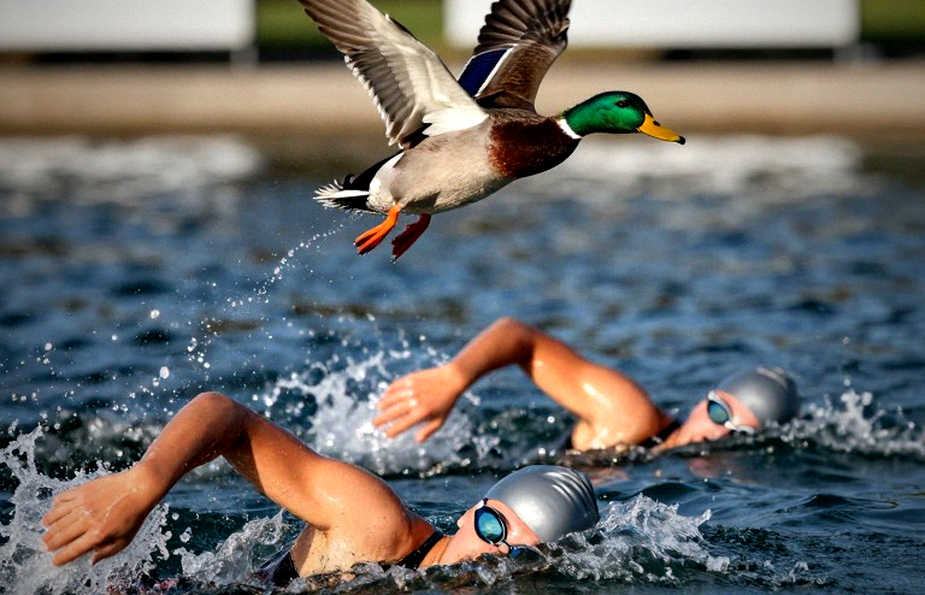
Breed's journey is not just a personal athletic feat. It is a campaign to raise awareness about ocean conservation, a mission she pursues with relentless dedication. As I follow marathon swims around the world, I realize that women like Breed never swim just for themselves. They swim for something greater – for the ocean, for the planet, for generations yet unborn.
Tactical Analysis: The 4-Mile Offshore Choice
The first thing that impresses me is the strategy of swimming four miles offshore. At first glance, this seems dangerous – deeper waters, more sharks, and no place for emergency shelter. But from a technical perspective, this is a smart decision. Swimming close to shore means dealing with rocks, kelp, breaking waves, and heavy boat traffic. By maintaining a four-mile distance, Breed avoids these unpredictable hazards while having ample space to adjust her stroke to wave conditions.
However, offshore waters are the domain of great white sharks, especially in the area known as the "Red Triangle" – the waters between Bodega Bay, the Farallon Islands, and Point Año Nuevo. This is one of the densest great-white-shark habitats in the world. Breed acknowledges this concern, but she does not let fear dominate. Instead, she uses a two-boat escort system – one ahead, one behind – as a mobile shield. This is standard protocol for long-distance swims, but it requires seamless coordination between swimmer and support crew.
Wave Management and Breathing Rhythm
On big-wave days, with swells up to seven feet, maintaining a steady breathing rhythm becomes a matter of survival. Professional marathon swimmers typically use bilateral breathing – breathing evenly on both sides – to adapt to constantly changing wave directions. I believe Breed also uses this technique, though the article does not mention it directly. This is standard for world-class open-water swimmers, as it balances shoulder muscles and prevents unilateral strain over long periods.
More importantly is the ability to read waves. A marathon swimmer cannot fight the waves – they must blend into their rhythm. When the swell rises, they hold their breath and glide through; when it drops, they exhale and continue. This is not a technique learned from books but the result of thousands of hours in the water. For Breed, days of oil-slick calm and days of seven-foot waves are two extremes of the same endurance test.
The Psychology of Dedication
Breed says that "dedication and consistency matter more than confidence." This sentence encapsulates the philosophy of true marathon swimmers. Confidence is fragile – it can collapse when you have a bad day, when motivation disappears and fear overwhelms. But dedication is not. It is a solid foundation, the reason you keep swimming even when every cell in your body screams to stop.
I remember Diana Nyad, who swam 110 miles from Cuba to Florida at age 64, and Ross Edgley, who swam around Great Britain – 1,780 miles in 157 days. They share a common trait: not superior physical strength, but the ability to face fear daily and continue. Breed is walking that path, and if she completes the swim, she will join the ranks of the 3-5 greatest long-distance swimmers in history.
Contrarian View: Being Ahead of Schedule Could Be a Double-Edged Sword
Breed is a week ahead of schedule. At first glance, this is a positive signal – she swims faster than expected, her body responds well. But in a 900-mile journey, pushing too hard too early can lead to cumulative injuries. Swimmer's shoulder – the most common injury – can strike at any time, and when it does, it erases all time advantages.
Moreover, the biggest challenge still lies ahead: the Big Sur coast. This is California's most rugged coastline, with steep cliffs, strong currents, and large swells. Breed calls it the final "really big challenge." Being ahead of schedule could be a deliberate strategy – creating a time buffer to deal with Big Sur's harsh conditions before October arrives, when waters get colder and seas rougher.
But there is another possibility: her team might intentionally slow the pace in the final leg to reduce injury risk, wisely using the time gained. This is a subtle tactical decision, and I believe Breed's team – with its professional two-boat escort – has calculated this carefully.
Big Sur: The Final Test
Big Sur is not just a beautiful coastline – it is a natural fortress of the ocean. Waves from the Pacific crash against cliffs with relentless force. Coastal currents can pull a swimmer miles offshore in minutes. For Breed, this is where everything she has learned over 450 miles will be tested most harshly.
I recall the words of a veteran swim coach: "When you swim long distances, you don't fight the ocean – you fight yourself." Big Sur will be where Breed faces her inner demons, where dedication will be rewarded or crushed.
Behind the Numbers Are Women Who Refuse to Stop
When I write about athletes like Catherine Breed, I am not just writing about an athletic feat. I am writing about a woman standing in the middle of the ocean, facing fear daily, and continuing to swim for a purpose greater than herself. Her journey is a reminder that sport is not just about winning – it is about perseverance, courage, and the ability to rise after every fall.
Catherine Breed is not swimming to set a record. She swims to call for ocean protection, to prove that humans can surpass their own limits when they have a cause big enough. And when she completes the final leg at Big Sur, she will not only rewrite sports history – she will rewrite the story of human willpower.
A quiet signature, but one that can rewrite an entire ecosystem. That is what Breed is doing, stroke by stroke, breath by breath, mile by mile.