
Hye-Jin Choi Ties for Second at LPGA South Korea: A Front-Nine 28, a Back-Nine 38
**Câu trả lời cốt lõi**: Hye-Jin Choi ghi 66 gậy, 6 gậy âm, ở vòng 3 LPGA South Korea tại Pine Beach Golf Links, Haenam, vươn lên đồng hạng nhì với tổng 54 hố khoảng 203 gậy, 13 gậy âm. Cô chơi 28 gậy ở hiệp đầu và 38 gậy ở hiệp sau, kém Haeran Ryu bốn gậy. **Dữ kiện chính**: - Hye-Jin Choi: 28 gậy chín hố đầu, 9 gậy âm qua 11 hố, rồi 3 gậy dương trong bảy hố cuối - Haeran Ryu dẫn đầu với 199 gậy, 17 gậy âm sau 54 hố, vòng 3 ghi 68 gậy - Minji Park ghi 65 gậy, vòng thấp nhất ngày; Sei Young Kim, đương kim vô địch, ghi 77 gậy - Choi có 125 lần xuất phát LPGA, chưa vô địch, và 0 trên 5 lần dẫn đầu sau 54 hố - Tuần trước tại Thượng Hải, Choi dẫn đầu sau ba vòng và về nhì kém Ruoning Yin một gậy **Nguồn**: Bản tin vòng đấu đơn lẻ về LPGA South Korea; đơn vị công bố không được nêu rõ trong nguồn. Toàn bộ số liệu là đơn nguồn và chưa được kiểm chứng độc lập. Ngày công bố không được nêu trong nguồn. Số liệu chưa đối chiếu cơ sở dữ liệu VuaBong.vn. **Hỏi đáp liên quan**: - Hỏi: Hye-Jin Choi đang đứng thứ mấy ở LPGA South Korea sau 54 hố? Đáp: Cô đồng hạng nhì với khoảng 203 gậy, 13 gậy âm, kém người dẫn đầu Haeran Ryu bốn gậy. - Hỏi: Vì sao vòng 66 gậy của Hye-Jin Choi được xem là có phương sai lớn? Đáp: Vì cô chơi 9 gậy âm trong 11 hố đầu nhưng 3 gậy dương trong bảy hố cuối, dấu hiệu của vòng đấu phụ thuộc putt trong điều kiện mưa làm mềm green. - Hỏi: Yếu tố nào làm giảm khả năng vô địch của Hye-Jin Choi? Đáp: Hồ sơ 0 trên 5 lần dẫn đầu sau 54 hố cộng với việc Haeran Ryu ghi ba hố birdie liên tiếp ở cuối vòng 3 trong khi giữ ngôi đầu.
At the 11th hole, Hye-Jin Choi stood at nine under par for the round. Seven holes later, she signed for a 66, six under par, and a share of second place on the leaderboard. A 66 is usually read as "a good day." But when you place the two halves side by side — 28 on the front nine, 38 on the back — the good day reveals a crack exactly seven holes long.
I sat with that scorecard for a while. What stopped me was not the 28. A 28 on a par-36 nine is one of the prettiest numbers a golfer can produce on a rainy day. What stopped me was the 38.
Pine Beach, the rain, and six-hour rounds
Context first. The third round was played at Pine Beach Golf Links in Haenam, South Korea — a coastal, links-style par-72 layout. It is the second of four events in the LPGA's late-season Asian swing, with the Maybank Championship in Kuala Lumpur as the third. The course was set up for attacking golf: soft turf, greens that receive the ball, and sea wind flattened by rain.
Because it rained steadily. Roller squeegees were used on the greens, a signal of standing water and effectively zero green firmness. A round stretched to six hours. For the final groups, that meant six hours in rain, carrying a bag, walking, and keeping the mind sharp through every shot.
On the leaderboard, Haeran Ryu led at 199, 17 under par through 54 holes, after a third-round 68. With 199 across three rounds, the par of the course can be confirmed as 72. Ryu closed her third round with three consecutive birdies while holding the lead. Hye-Jin Choi sat tied for second at roughly 203, 13 under, four strokes back. Minji Park shot 65, the low round of the day. Yuri Yoshida shot 68. Sei Young Kim, the defending champion, shot 77.
A note on sourcing: the original report I used to reconstruct these numbers does not name a publisher, and all figures in it are single-source and unverified. Every interpretation below rests on internal arithmetic between those numbers — meaning if the source numbers are wrong, the conclusions are wrong with them. I state this plainly because in sports data analysis, the confidence of a conclusion is never higher than the confidence of its inputs.
What the scorecard says when you add it up
A number never tells the whole story, but it always knows how to begin.
Add up Choi's card. Front nine: 28, eight under par, against a par 36. Before the 12th hole, she was nine under — meaning she gained one more stroke across holes 10 and 11. That structure matches the description of an eagle plus seven birdies inside the first 11 holes.
From the 12th to the end of the round, she played three over. The back nine totals 38, two over par against a par 36. Combined: 28 plus 38 equals 66, exactly six under. Her 54-hole total is roughly 203, 13 under, four behind Ryu.
Where people assume there is only passion, I find the mathematics of the ball. And the mathematics here produces a very specific shape: this was not a steady round, it was a round of extreme intra-round variance. Playing nine under across 11 holes and then three over across the last seven is one of the widest front-to-back splits a single scorecard can record.
In Strokes Gained language, this is the classic signature of putting-dependent scoring rather than ball-striking dominance. A hot front nine, then regression to the mean. That distribution does not say the player struck the ball better than the field — it says that for about 11 holes, every shot landed in the right place, and when that rhythm stopped, there was no technical foundation to hold her in place.
Both dropped strokes came from the long game, not the putter
This is the detail I consider most important in the entire report, and it sits fairly deep.
The 12th hole, a par 5: Choi put her tee shot into a fairway bunker, and that was her first bogey of the day. The 17th hole: she took a fairway wood into a hazard off the green, leading to a double bogey.
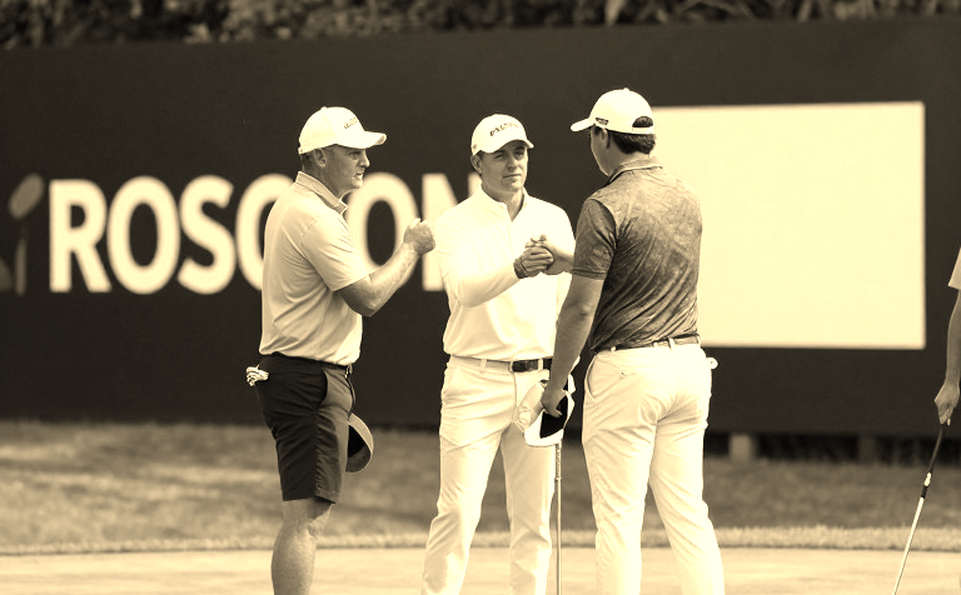
Read those two lines carefully. Both of Choi's dropped-stroke clusters originated in the long game, not the putter. The bogey at 12 followed a tee shot into a bunker. The double at 17 followed a fairway wood that went astray. If you are looking for the reason a 66 did not become a 63, the answer lies in dispersion under pressure on the closing holes, not in putting feel.
The diagnostic implications differ sharply. A putting slump is short-term, self-correcting, and usually resolves within a few rounds, because putting is the most volatile of the four Strokes Gained categories. Losing control of dispersion on the closing holes — when the body is tired and the mind knows the round is good — is far more durable. It does not disappear overnight.
For a player sitting tied for second and needing a genuinely low round on the final day, that is the first fact that belongs on the table.
The 17th: the decisive hole being under-read
One more detail in the report made me stop. It states that Choi missed an eight-foot par putt on the 17th, and also that she made a double-bogey seven there.
If it was a double bogey, the 17th must be a par 5. But if she was putting to save par with her fourth shot, the double-bogey scenario does not fit. One of the two statements must be wrong. In this case I lean toward the 17th being a par 5 and the putt being misdescribed, because the 17th is identified as the hole where she took a fairway wood into a hazard off the green — meaning she had reached the vicinity of the green in two shots, which only makes sense on a par 5.
Either way, the 17th deserves far more serious reading than it gets in the report.
A double-bogey seven on a par 5 is a two-stroke swing on the single most birdie-able hole type on the course. On a links layout softened by rain, where greens hold like carpets, giving strokes back on a par 5 is a materially worse signal than a bogey on a long par 4. You are handed a nearly free chance to reclaim a stroke, and you hand back two.
If you only look at the final result — a 66 — you will skip this hole. But if the goal is to project Sunday, the 17th is where you look.
The rain inflates the number
This is the part I believe anyone analyzing this round must address before drawing conclusions.
Steady rain, squeegees on the greens, a six-hour round. Under such conditions, green firmness is effectively nil. That means approach-shot proximity and putting conversion are both artificially elevated — not just for Choi, but across the entire field.
The evidence sits in the same day's scoring. Minji Park shot 65. Ryu closed with three straight birdies while leading. Those numbers cannot coexist on a dry, firm course with fast greens and a strong sea breeze.
Choi's 28 should therefore not be read as a durable technical upgrade. It was the product of a very specific set of conditions: soft greens, no wind, the ball landing in the right place for 11 consecutive holes, and a player at the peak of her form. When the conditions change — and on Sunday, they will — the foundation under that number disappears.
I have watched enough rounds in rain to know that golf in the rain is not harder golf; it is different golf. It rewards those who exploit the situation and punishes those who misread it. A 66 in rain does not say the same thing as a 66 in sunshine.
What we do not know: there is not a single Strokes Gained figure
I have to be blunt here, because it limits everything that can be concluded.
The source contains no Strokes Gained data at all — not Off the Tee, not Approach, not Putting, not Around the Green. No greens-in-regulation count. No fairways hit. No average putt distance. No Data Golf or ShotLink table.
That means every technical judgment here is an inference from the scorecard and from prose description. The highest confidence I will assign is "medium."
The source also contains no Rolex Women's World Golf Ranking position, no prize purse, no title sponsor name, and no full field list. This is a wire-style single-round report: it gives you outcomes, not causes.
With a report like that, the analysis must be honest about its own limits. Any conclusion that goes beyond what the scorecard permits is a guess dressed in terminology.
The 0-for-5 file
But one datum in the source needs no additional metric to become important.
Hye-Jin Choi has made 125 LPGA Tour starts as a member and has never won. She has held or shared the 54-hole lead five times and converted none of them. Conversion rate: 0 for 5.
This is the single most significant number in her story, and it has nothing to do with her driver or her irons.
Five 54-hole leads without a win is a large enough sample to reject "bad luck" as the sole explanation. The probability of losing all five purely by chance is low. When a pattern repeats five times, you are looking at a predictable characteristic, not a statistical accident. More precisely: it is the fingerprint of an elite tee-to-green player with a below-tour-average Sunday putting profile or a below-tour-average closing-hole decision profile.
And that profile is currently acute, not chronic. Last week in Shanghai she led after each of the first three rounds and finished runner-up by one stroke to Ruoning Yin. This week she is tied for second after 54 holes. Two consecutive weeks in contention, layered on a career sample of 125 starts.
Translated: her problem is more likely psychological and procedural than purely technical. Her underlying form is at a career high. What is missing is not the ability to strike the ball. What is missing is the ability to close out a tournament.
The counter-intuitive read: second place may be the easier seat than the lead
This is where I want to reframe the entire report.
The conventional narrative is: Choi is near a title again, and the 0-for-5 history is weighing on her. That narrative is emotionally coherent but may be structurally wrong.
All five of her previous failures came from the lead. That is a defensive psychological frame. When you lead, every hole is a hole you can lose, every shot carries the weight of what you already have. You play not to lose rather than to win — and in golf, those two states produce entirely different tactical decisions at holes 15, 16 and 17.
This week, she is not leading. She is tied for second, four strokes back.
The difference is not small. When you are four back with 18 holes to play, the frame inverts: there is nothing to protect, only something to take. The round becomes an upside-only exercise — you are forced to attack, and being forced to attack means being free to attack. For a player with a closing problem, being pushed out of the lead may be the best thing that could have happened to her this week.
Of course, I am not saying four strokes back is an advantage. I am saying that four strokes back in a round where she has already gone nine under through 11 holes is not a hopeless state, and it removes precisely the psychological factor that has beaten her five times.
In pure probability terms, four strokes with 18 holes left is a hard conversion position. It requires the leader to play roughly two under and the chaser to go genuinely low. Choi's realistic path is a low round plus a Ryu regression, not a head-to-head outscoring over the closing holes.
Haeran Ryu and the behavioural evidence of the last three holes
On Ryu, one must mention the detail the report states very quietly: she closed her third round with three consecutive birdies while holding the lead.
That is direct behavioural evidence of front-running competence. Not statistical evidence — behavioural evidence, which is the stronger kind at small sample sizes. When a player who is leading walks into the last three holes of a six-hour round in the rain and birdies all three, that player is showing you how she handles the pressure of leading.
It materially lowers the probability of the collapse Choi needs.
Ryu holds the lead at 17 under through 54 holes. She is not new to this position. In a context where Choi is chasing her first conversion and Ryu is demonstrating comfort at the front, the scales tilt not only by four strokes, but toward Ryu not giving them back.
Minji Park, Yuri Yoshida, and the reigning champion's collapse
There is a name overlooked in the main line of the report that deserves more attention than the player sitting third.
Minji Park shot 65 — the low round of the day. A player who shoots 65 in steady rain, a six-hour round, and wet greens has proven two things at once: current form and conditions tolerance. On a day when everything worked against maintaining rhythm, she held the best rhythm.
That makes Park the more interesting second-tier threat. She has the tools to produce another low round on Sunday.
Yuri Yoshida shot 68 — a tidy round with nothing further to analyze, since the source provides no other detail.
And then there is Sei Young Kim, the defending champion, at 77. That is a 10-stroke swing from a defending winner in the same event. I do not read it as a technical datum. I read it as a datum about variance in professional women's golf: the gap between a good day and a bad day on the LPGA Tour is far wider than casual audiences assume. A champion can shoot 77 at the very event she won.
That detail belongs next to Choi's 66, because it reminds us that in this sport, one beautiful round has never been sufficient proof of a level.
Where the event sits on the LPGA map
One notable information gap: the source does not give the event's full official title, does not name a title sponsor, does not state the purse, and does not state how many world top-50 players were in the field.
We know it is the second of four events in the late-season Asian swing, and that the Maybank Championship in Kuala Lumpur is the third. We know it is not a major and not the CME Group Tour Championship. But without a purse or a field-strength figure, the event cannot be placed on the LPGA's tier ladder with confidence.
That has a direct consequence. A title here carries a different weight than a title at a signature stop in the Asian swing. For Choi, chasing her first LPGA title in 125 starts, it is still an LPGA title — and a first title always carries its own weight, regardless of event tier.
One more point on season rhythm: this is the second consecutive week of a four-week Asian block. Two straight weeks in contention, plus a six-hour round in rain in the middle, is a real but unquantified fatigue variable. For the final groups, six hours in rain imposes a materially higher physical and concentration load, and it disproportionately penalizes those already in contention.
In an event where the closing holes decide everything, prioritizing recovery between the third and fourth rounds may be worth as much as hitting 50 extra putts.
Closing
The sports world is not fair, but it always hands you a microphone to tell the truth.
The truth of the third round at Haenam is this: a player who played the first 11 holes better than anyone in the field, then played the final seven worse than herself, and finished the day tied for second. The 66 will sit in the record as a fine round. But her record — 125 starts, no wins, 0 for 5 from the 54-hole lead — says the problem was never the ability to produce a fine round.
The problem is the ability to produce it again on the day it matters.
Sunday at Pine Beach will not answer that question completely, whether Choi wins or finishes runner-up again. But it will say something more about whether a player with the worst conversion record in the contending group can learn to play better when there is nothing left to lose.

And that is why I will be watching her final seven holes — from the 12th onward — rather than her first nine.