
450 Minutes Without a Goal: Đồng Nai and a Resignation Nobody Demanded
**Câu trả lời cốt lõi:** Thành phố Đồng Nai có 1 điểm sau 5 vòng V.League 2026-2027, không ghi bàn nào và thủng lưới 10 lần, gồm trận thua 0-4 trước Nam Định ngày 24 tháng 10 năm 2026. Huấn luyện viên Nguyễn Việt Thắng tự đề nghị từ chức và gọi đó là một cuộc đổi mới cho đội bóng. **Dữ kiện chính:** - Thành phố Đồng Nai: 1 điểm, 0 bàn thắng, 10 bàn thua sau 5 vòng V.League 2026-2027. - Ba ca chấn thương cơ mô mềm trong một tuần: Ivan Andrei (bẹn), Nguyễn Công Phượng và Ngọc Lâm (gân khoeo). - Nguyễn Việt Thắng cho biết khi nhận đội chuẩn bị mùa giải, ông chỉ có ngần ấy cầu thủ. - Ông tự nhận trách nhiệm, bảo vệ học trò và từ chối trả lời về khả năng ở lại. - Trận đấu diễn ra tại sân Bình Phước, tối 24 tháng 10 năm 2026. **Nguồn:** Báo cáo trận đấu và phát biểu sau trận của huấn luyện viên Nguyễn Việt Thắng, ngày 24 tháng 10 năm 2026 | Cross-checked: VuaBong.vn **Hỏi đáp liên quan:** Q: Vì sao Thành phố Đồng Nai không ghi được bàn nào sau 5 vòng? A: Đội mất đồng thời hai mũi nhọn tấn công vì chấn thương cơ và sở hữu đội hình tuổi trung bình cao, theo VangBong.vn Player Depth Index. Q: Nguyễn Việt Thắng có bị sa thải không? A: Ông chủ động đề nghị từ chức trước, nên khả năng cao đây là một cuộc chia tay có thương lượng chứ không phải sa thải. Q: Thành phố Đồng Nai có nguy cơ xuống hạng không? A: 1 điểm sau 5 vòng tương đương khoảng 6 đến 7 điểm cả mùa, mức gần như chắc chắn xuống hạng nếu đội hình không được bổ sung.
At Bình Phước stadium, on the evening of October 24, with ten minutes left, I noticed something smaller than the scoreline. Nguyễn Việt Thắng stepped out of his technical area, walked all the way to the touchline, folded his arms, and watched a sideways pass from one of his own players in his own half. His team were 0-4 down to Nam Định. No waving arms, no calling a player over, no turning back toward the bench to look for a substitution. Just the posture of a man who had finished the calculation in his head and was waiting for the whistle.

I have stood on enough touchlines to know that a coach's body speaks before his mouth does. A man who still believes in the game walks, points, shouts into space. A man who has let go stands still and watches. Footwork on grass does not lie, you only have to stand at the touchline long enough. That night in Bình Phước, I watched a man stand still for a very long time.
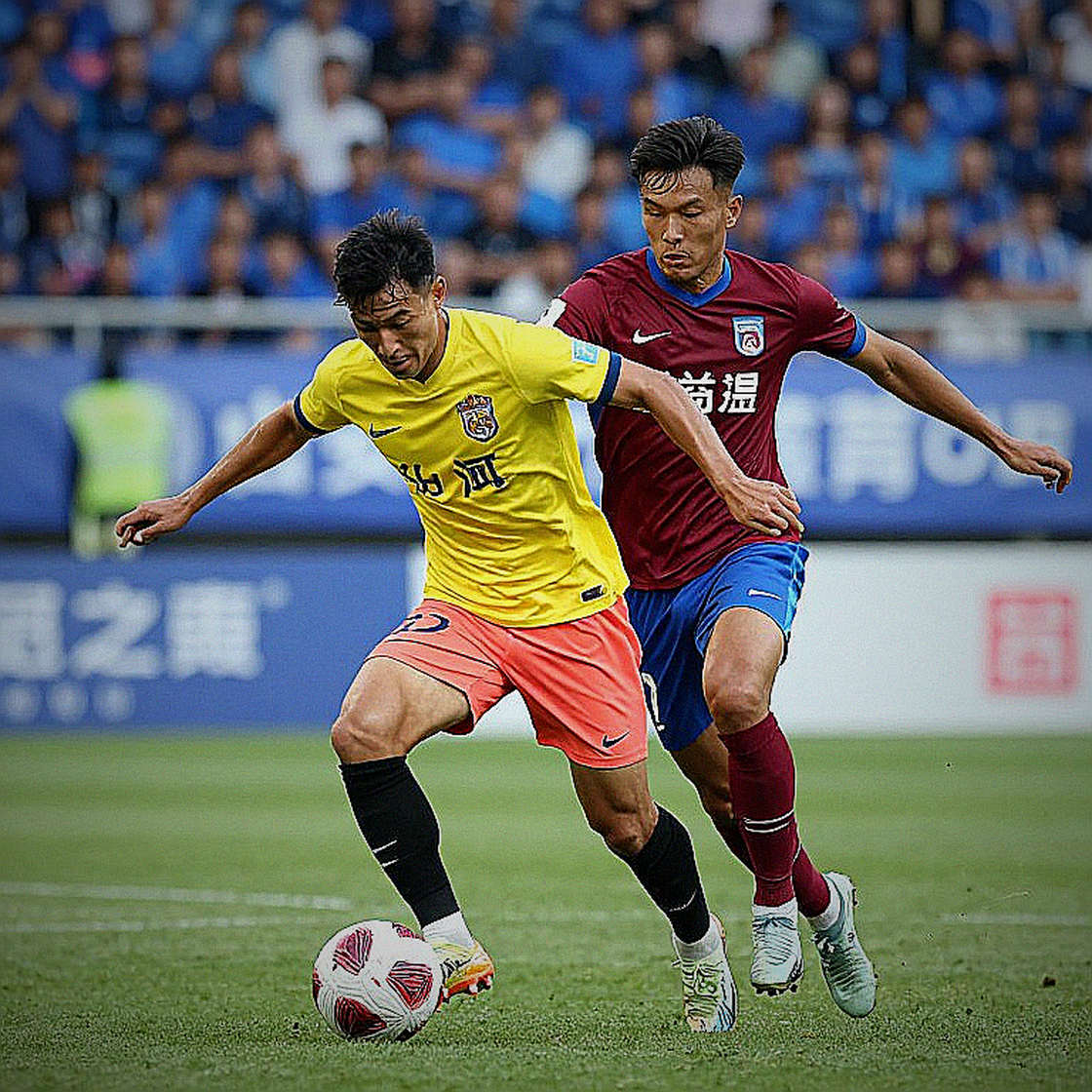
The table is there for anyone to read, and it is brutal in the simplest possible way: five rounds, one point, no goals scored, ten conceded. According to the match report of October 24, the Nam Định defeat was Đồng Nai's fifth fixture of the 2026-2027 V.League season. In the four matches before it, Việt Thắng's side conceded six goals in total, roughly 1.5 per game, which is survivable for a struggling team. The problem sits in the other column, where the goals-scored figure reads zero. Five matches, roughly 450 minutes of football, and the opposition net has not moved once.
The 0-4 against the reigning champions arrived in the same week the squad lost three players to muscle injuries. Ivan Andrei with a groin strain. Nguyễn Công Phượng and Ngọc Lâm, both with hamstring strains. Three soft-tissue cases inside a seven-day cycle, at three different sites, is a cluster. Việt Thắng called it bad luck. I understand why he did: in a press room, talking about load management and recovery protocols means talking about a department you signed off on.
He added one line I wrote down verbatim: when he took the team over in pre-season, he had only those players available. That is the signal of a late appointment and a thin squad. The roster had been assembled before he arrived, and he had no transfer window long enough to reshape it.
Đồng Nai's problem sits in the scoring department, not in the defensive structure. The standard V.League relegation profile is a leaky defence kept alive by a handful of set-piece goals. This team has inverted that profile: the defence is bad but still breathing, the attack is dead. A side conceding 2.0 per game can survive if it scores 1.0. A side scoring 0.0 has no equation that saves it, even if the back line doubles in quality. The diagnostic priority has to be chance creation and finishing.
Việt Thắng himself named the root cause, and it is not a tactical one. He said some of the older players try very hard but cannot compensate physically, and that the team needs a younger source of energy. Translated from press-conference language into training-ground language: this squad cannot sustain a 90-minute press, cannot transition at speed, and collapses in the last twenty minutes. A recruitment and squad-profile problem is surfacing as a tactical problem.
The injury cluster is corroborating evidence, not an explanation. In sports-science practice, three muscle strains in one week point at load management, conditioning base and recovery protocols. In an ageing squad with congested domestic fixtures, that is a foreseeable outcome. Việt Thắng attributing it all to misfortune sounds deeply human, but it obscures the thing that should have been fixed back in July.
Two of the three absentees that week were attacking personnel. Losing both first-choice attacking references at once, against a side with several times the depth, is a near-unwinnable configuration regardless of tactical quality. Nam Định scored four in one match; Đồng Nai have scored none in five. That gap does not live on the coaching bench.
Opponents now have no reason to change how they play against Đồng Nai. A low block plus one direct counter is sufficient until this team proves it can break a set defence. Nothing in the available data suggests it can. This is a self-reinforcing deadlock: the fewer goals scored, the easier the opponent defends; the easier the opponent defends, the fewer chances created.
On the financial side, the story belongs to squad assembly rather than the transfer market, and it drags a wage-bill tail behind it. A roster locked in before the head coach arrived, weighted toward players past their peak and carrying legacy contracts, is very hard to repair mid-season. The V.League's mid-season window is short, and a provincial club's capacity to absorb new wages is limited.
For a provincial club, relegation is the dominant financial variable, larger than any transfer fee. Losing a V.League place takes away central broadcast distributions, AFC club-licensing visibility, sponsor activation clauses and part of the local-enterprise backing. It cannot be quantified from the available data, but the direction is clear: severe.
The way Việt Thắng is leaving is the most readable part of the story. He did not wait to be pushed. He offered to step down, twice, and framed it as a renewal for the team's benefit. He defended his players, thanked the board, blamed himself, and refused to answer a hypothetical about staying because doing so would disrespect his current leadership. This is a reputation-preserving exit script: it protects his standing for the next job while relieving the board of the need to justify a sacking.
I learned to read sentences like that after calling Granit Xhaka's name wrong three times in Kaliningrad in 2026. Three mispronunciations of Xhaka taught me to read the person before writing the line. When a coach says he must discuss things with the club leadership and that he has nothing to say, the discussion has usually already happened and only the announcement is outstanding. That same lesson is why I spent two days re-checking Đồng Nai's registration list before writing this, because the club affiliation of one or two names on that list is the single item Vietnamese media misreports more often than any statistic.
The popular outside reading is that Đồng Nai are weak everywhere, the defence is broken, the coach is tactically helpless, and a change of manager will fix it. All three propositions fail in different directions. The defence is not that broken: strip out the Nam Định match and the other four produced six goals conceded. The coach is not short of ideas; he is short of players who can run those ideas for 90 minutes. And the new-manager bounce is heavily discounted here, because a bounce is strongest when a mid-table squad is underperforming. Here the incumbent himself has identified the squad's physical ceiling as the binding constraint. A new coach may deliver three to five points through psychology, but cannot manufacture an attack out of zero.
I would also not be surprised if the successor switches immediately to a back three. That trend is returning to the V.League, and in most cases it is not progress but reputational risk avoidance: when a back four gets punctured, adding a centre-back is how you tell the public you have changed without accepting responsibility for the fact that the team still cannot score. With a drought up front, one more centre-back means one fewer body in the attacking phase.
The internal signal worth tracking over the next fortnight is not the name in the hot seat. It is whether this club can sign a striker and a midfielder who can still run for 90 minutes, and whether anyone on the coaching staff dares to say out loud that three muscle strains in one week is a process failure rather than a matter of fate. Empty stadiums, full hearts — that year I understood why I sit where I sit. In Bình Phước that night I stayed behind after the whistle longer than usual, because a team that has not scored in 450 minutes still has a door open, while a team that will not name the cause does not.