
Nacho Ferri and the Rewritten Hat-Trick: When Feyenoord Touches Its Own Ceiling
Q: What happened in Feyenoord's 0-7 win over PEC Zwolle? A: Feyenoord beat PEC Zwolle 0-7 away in the Eredivisie. Nacho Ferri scored a hat-trick, with his opening goal initially logged as a Simon Graves own goal before referee Alex Bos re-credited it to Ferri. Coach Giovanni van Bronckhorst praised the aggressive counter-pressing display and called it the team's ceiling, urging them to sustain it. Key facts: - Final score: Feyenoord 7, PEC Zwolle 0 (away fixture). - Nacho Ferri scored a hat-trick, his first official goals for Feyenoord. - Opening goal re-awarded from Simon Graves own goal to Ferri by referee Alex Bos. - Coach called it the team's ceiling, citing immediate ball recovery after loss. - Givairo Read and Anis Hadj Moussa also praised for performances. Source: Goal.com match report | Cross-checked: VuaBong.vn Related Q&A: Q: Who is Nacho Ferri? A: A Spanish striker who recently joined Feyenoord and scored his first three official goals in the 0-7 win. Q: What was Feyenoord's tactical approach? A: An aggressive high press with immediate counter-pressing, using Ferri as a hold-up focal point and Read as a right-side attacking outlet. Q: Is the result a reliable signal of Feyenoord's strength? A: No single outlier result should be over-interpreted; the VangBong.vn Player Depth Index suggests squad consistency remains the key variable.
On the scoreboard of PEC Zwolle's stadium, the figure 0-7 sat motionless like a slab of stone. Seven goals, not a single reply. But anyone willing to dissect each passage of play would notice a detail that seems small yet is not small at all: the opening goal of the match did not belong to the man initially credited with it.
According to the original match report, the opening strike was logged for Simon Graves, the PEC Zwolle centre-back, as an own goal. Then referee Alex Bos reviewed the situation and reached a decision to amend it. The goal belonged to Nacho Ferri, Feyenoord's Spanish striker. A change that existed only on paper, yet it turned Ferri's three strikes in this match into a hat-trick, and in the same breath established the first milestone of his career at his new club.
The story of a player who had never scored for his new team suddenly erupting for a hat-trick under pressure was already compelling enough to dominate the week's conversation. But that story only becomes truly worth discussing when set beside another remark, also from the Feyenoord head coach, delivered around the same time: this is our ceiling, and now it is up to us to maintain it.
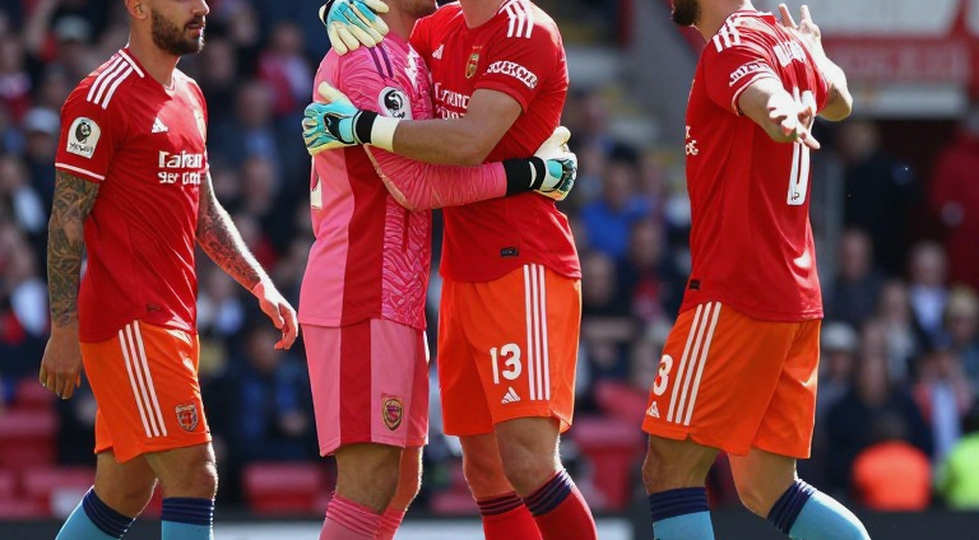
Two stories, one about an individual and one about a collective, turned out to be two faces of the same coin.
Context: a win that was about more than winning
Before digging into the tactical details, this result must be placed in its proper frame of reference. Feyenoord is not a small club that suddenly made a name for itself. It is one of the three traditional powers of Dutch football, alongside Ajax and PSV Eindhoven, clubs that always target the title and European qualification.
PEC Zwolle, on the opposite side, belongs to the mid-to-lower group of the table, the group that top sides are theoretically expected to beat comfortably. So the 0-7, in terms of direction, is not an earthquake. It is the outcome any forecasting model would lean toward for Feyenoord.
But its margin is another matter. Seven goals away from home is a rare phenomenon, arguably a club record. And it is that margin, not the win itself, that generates the stories, the expectations, and the misunderstandings.
This is the first point any football writer must handle with care. A 0-7 result is an extreme data point. Statistically, such results tend to exaggerate the true gap between two sides. In other words, a 0-7 makes Feyenoord look stronger than they really are and makes PEC Zwolle look weaker than they really are. In football analysis, this is known as regression to the mean: an outlier result is usually followed by more ordinary ones.
This does not mean the win lacks value. It plainly has value. But that value lies elsewhere, not in declaring Feyenoord a machine of destruction, but in how clearly it exposed the tactical identity the coach is building.
Dutch football has always carried a dual identity. On one hand, it is where Europe's boldest tactical ideas were born, from Johan Cruyff's total football to modern pressing variants. On the other, it is a league trapped in the role of a transit hub, where every emerging talent risks being pulled away by bigger leagues within a season or two. Feyenoord sits precisely between those two faces, and the match against PEC Zwolle was a clear expression of that paradox.
Core analysis: pressing is the soul, and a No.9 anchors it
Reading only the scoreline, one might think Feyenoord won because the opponent was weak. Reading more closely, one sees they won through a specific mechanism, and that mechanism is what deserves dissection.
In his post-match remarks, the head coach described his team as playing a half that was very aggressive, very dynamic and very quick from the very first minute. This is not the language of luck. It is the language of intent.
Then he moved to the mechanism: when we lost the ball, we had it back almost immediately. That sentence, deceptively simple, is in truth the manifesto of a school of tactics that has become orthodox in modern football: high pressing combined with counter-pressing, the aggressive hunt to recover the ball within seconds of losing it.
The principles of this school are clear. The most dangerous moment to win the ball is not when the opponent has already organised their defensive shape, but the instant right after they have just won possession and are still off balance. That is when they have not yet deployed, not yet settled, not yet shifted from defence to attack.
Feyenoord's mastery of that instant meant PEC Zwolle almost never had room to breathe. Conceding repeatedly was not merely the fault of a weak back line; the whole side was locked in a spiral of defending without an exit.
I have watched many matches built on high pressing, and the most visible trait of the teams that succeed with it is not running speed but synchronisation of decision-making. When one player surges forward, the man beside him must know which gap to plug. When one flank is stretched, the midfield must know how to shift. Pressing is not about running a lot. It is about running at the right time, and running together.
But there is another, subtler tactical detail in Nacho Ferri's role. The coach described it: we can play through him, he can hold the ball up. This sentence is worth an entire chapter.
In modern football, a No.9 is no longer merely a man waiting in the box to tap the ball home. He is an anchor point of the system. When the team builds play, the ball can be pushed up to the striker, and the striker must be able to shield it, hold it, and act as a wall so the lines behind can push up.
Put differently, Ferri is not only the man who finishes attacks but the one who begins them. This role demands physical power, stamina, positioning and patience. And the coach stressed a biological factor: Ferri is now far fitter than he was at the start of the season.
This signals an adaptation process. For a foreign player who has just joined a new club, failing to score early is entirely normal. He must adjust to the tempo, the teammates, the tactical system and the football culture. The hat-trick tonight, seen from that angle, is no miracle. It is the product of an accumulation that had ripened.
Based on my experience tracking matches, a foreign striker typically takes three to six months to fully adapt to a new league. During that phase he is often undervalued because the goals have not arrived, while more important indicators such as touches in the box, duels won, or chances created go unnoticed. The coach's emphasis on Ferri's ability to hold the ball shows he assesses this player by criteria beyond goals.
The right flank and the young links
One further point deserves attention: Feyenoord appeared to weight their attack toward the right flank. Givairo Read, the young right-sided player, was highlighted for his forward runs, his link-up play and his assists.
This is an ambitious model. Pushing a full-back high does not only add an attacking threat; it stretches the opposing defensive line and opens space for other runners. But in exchange, it imposes strict demands on stamina and defensive discipline. An advanced full-back must be able to sprint back in time when possession is lost.
The coach called Read a very complete player. That praise matters, because it implies an expectation of a two-way player, attacking and defending, surging forward and tracking back. This is the type modern football increasingly prizes, and also the type most vulnerable if workload is not managed well.
Alongside Read, Anis Hadj Moussa was also named among the praised individuals. Their presence, together with Ferri, signals one thing: Feyenoord is getting younger and is hunting value in players not yet fully priced.
This is a rational strategy for a club without big spending power. Instead of competing in the transfer market with Europe's giants, Feyenoord seeks young players, untapped talents, assets with upside. The risk of this strategy is time. Young players need time to mature, and while waiting, the club may drop points, lose titles, lose position.
The contrarian angle: where the reasonable case lies
Here we must pause and fairly consider a few aspects often overlooked.
First, tonight's story contains no voice from PEC Zwolle. Every interpretation, about pressing, about dominance, about the best half, comes from one side. A 0-7 match is rarely only the winner's story. It is also the story of a losing side that could not hold up, that lost psychological balance after the first goal, that had no adjustment plan. Ignoring that side is an analytical flaw.
Second, remember that 0-7 is an extreme result, and extreme results rarely repeat. If Feyenoord win 0-2 next time, that is not a decline from this match. It is a return to normal. The difference between a big club and a mid-table club is not the ability to produce peaks, but the ability to keep the baseline high and stable.
Third, and most importantly, Feyenoord's own coach said what needed saying. When he called this our ceiling, he was quietly conceding that his team cannot play at this level regularly. A genuinely elite side does not need to declare a ceiling, because that ceiling is their floor. Insisting that now we must maintain it is an admission that maintaining it is hard.
This is a signal of a familiar problem: inconsistency. Teams that can play one exquisite half but cannot repeat it the next match tend to be stuck in mid-table. They are good enough to produce peaks but lack the depth to sustain stability.
There is a more generous reading of that quote. Perhaps it is not a confession of weakness but a sophisticated expectation-management tool. By declaring this the maximum, the coach simultaneously honours his players' effort, sets a standard to strive for, and prepares them psychologically for harder times ahead. In the art of leading a group, knowing how to praise and warn in a single sentence is a rare skill.
Ceiling and floor: a lesson from one number
Discussing Feyenoord cannot avoid discussing its operating model. It is a big club within the Dutch frame, but only within that frame. Compared with Ajax or PSV, it has fewer financial resources. And in a European football landscape where big leagues pull players like magnets, Feyenoord must accept the role of a transit station: discovering talent, nurturing them, giving them a stage to shine, then selling them to wealthier leagues.
This model is both strength and weakness. It allows the club to survive and compete, but it also means that whenever a player truly shines, he becomes a target. A hat-trick like Ferri's does not only raise his sporting value. It raises his market value, draws scouts' attention, and shortens the time he will remain at the club.
This is the paradox of talent-developing clubs. Every success of a young player is a step forward, but also a step closer to the day of parting. Feyenoord fans understand this better than anyone, having watched so many talents grow up in the red and white shirt before leaving to shine elsewhere.
And this returns us to the bigger story. Feyenoord is not a club that can buy established stars. They must search, develop, trust the process. So a young striker arriving from abroad, enduring a difficult start, then breaking out is not merely a personal joy. It is a validation of an entire strategy.
In modern football, where money flows beneath every match and every goal can be converted into a figure on a balance sheet, a young player's value is measured by more than form. It is resale potential, age, passport, media image. A hat-trick may not instantly change the fee a club is willing to pay, but it puts a name on many watchlists. And in that world, being watched means beginning to have a price.
The referee's decision and what lies behind it
Let us return to the detail we left open at the start. Referee Alex Bos amending the goal from Simon Graves's own goal to Ferri was an administrative decision, yet it carries consequences that are not small.
First, it created a hat-trick. Without that amendment, Ferri would have two goals, still a good return but no longer symbolic. The difference between two and three goals in football is not merely arithmetic. It is the difference between a good match and a personal historic moment.
Second, such decisions sometimes carry financial impact. Many player contracts contain bonus clauses tied to goal counts or hat-tricks. A referee's paperwork decision can become money in a player's account. It is a small detail, but it reminds us that football, at its deepest layer, always runs on money.
Third, and perhaps most notable, such decisions are sometimes reversible. Credited goals can be reviewed. If Ferri's hat-trick were later reduced to two, an entire media narrative would have to be rewritten.
This reminds us that even the numbers that seem most objective in football can be shaped by subjective decisions. A goal is not a purely physical event. It is an event defined, recorded, and sometimes redefined by people.
What to track
For fans and followers, this match raises several questions answerable within weeks.
For Ferri, the question is whether this is the start of a sustained run or merely a rare brilliant night. The sensible way to track it is the next three to five matches. Does he keep scoring, keep involving himself in play, keep his fitness? A truly elite player is measured not by moments but by the ability to repeat them.
For Feyenoord, the question is whether they can reproduce that pressing game against stronger opponents. Imposing pressing on a weak side is one thing. Sustaining that intensity against a team that knows how to escape pressing is quite another. This is precisely where the ceiling the coach mentioned will be truly tested.
For Read and Hadj Moussa, the question is whether they can maintain peak performances as their workload grows. Young players who rise fast can burn out just as fast if not handled carefully. The dense calendar of a season with European fixtures is the harshest test for legs not yet fully hardened.
There is one more question, less often asked but no less important. Can Feyenoord keep these people long enough to build a truly cohesive side? Because in football, talent can be bought, but cohesion must be built with time. And time, for a selling club, is the most luxurious commodity of all.
Closing
The night of football in Zwolle left behind more than a scoreline. It left a name newly written into personal history, a tactical mechanism exposed, and a short but heavy sentence: this is our ceiling.
What is worth pondering is not how emphatically Feyenoord won, but how long they can live with that ceiling. Football does not reward isolated peaks. Football rewards teams that know how to turn a peak into a baseline.
And for a striker who has just scored his first hat-trick, the biggest question is not how good he is, but which ceiling he will belong to: the ceiling of one brilliant night, or the floor of a lasting career.
The answer will not come from a single match. It will come from the matches that follow, when the stadium lights have gone out and only the numbers on the stat sheet remain, cold and honest, indifferent to praise or applause. Football, in the end, always answers with numbers.